AI Is Changing the Evidence Cycle. Is Medical Affairs Ready?
AI is reshaping the evidence cycle. For Medical Affairs, Clinical Development and HEOR, the opportunity extends far beyond productivity: AI tools can help rethink and redesign how evidence is identified, generated, disseminated and accessed.

For the past two years, discussion about AI in healthcare has focused on productivity. General-purpose AI tools such as ChatGPT, Claude and Microsoft Copilot can accelerate literature review, knowledge synthesis, and meeting documentation. However, this is only the most visible layer of a deeper transformation.
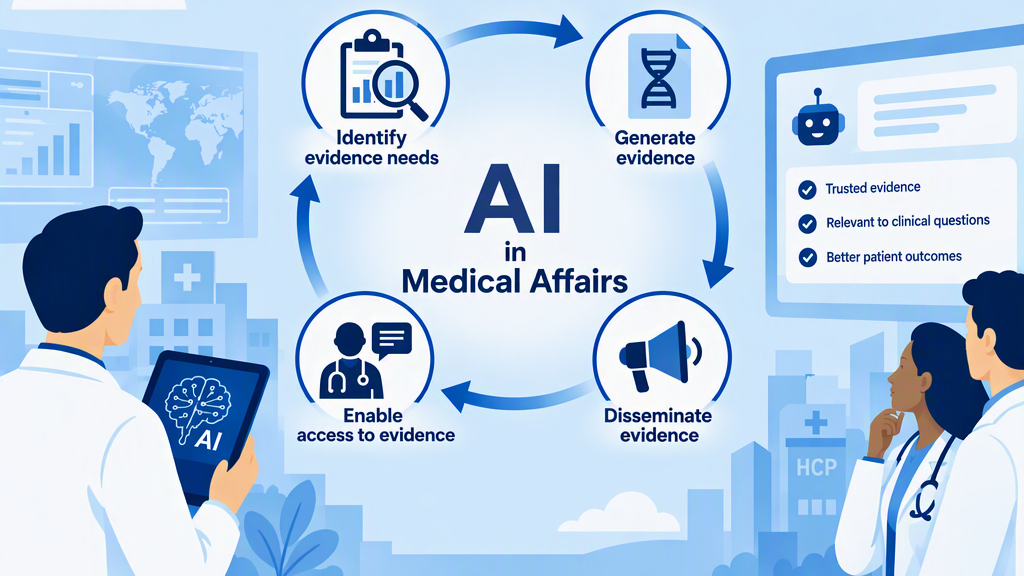
AI is beginning to change how evidence needs are identified, how evidence is generated and shared, and how healthcare professionals find and apply it. Together, these developments are reducing the distance between an evidence need and an evidence-informed decision.
The strategic opportunity is not simply to help evidence teams work faster, but to redesign the evidence cycle itself.
Identify emerging evidence needs
AI can build a holistic picture of emerging evidence need. Insights from HCP-facing AI platforms, MSL interactions and other needs assessments can be considered together to detect recurring unanswered questions. Patterns relating to patient populations, treatment sequencing, endpoints or evidence limitations may indicate where additional research, education or scientific communication is needed.
These insights can be incorporated into early Integrated Evidence Planning (IEP), enabling evidence priorities to reflect evolving HCP needs and knowledge gaps and supporting faster, more targeted evidence generation to address them.
Transform evidence generation
Producing high-quality clinical and real-world evidence has traditionally required complex workflows involving multiple internal stakeholders, external partners and long delivery timelines. Emerging healthcare-native AI platforms are beginning to challenge that model.
Unlike general-purpose AI tools, these systems are purpose-built for research workflows. Organizations such as AWS, Databricks, Datavant and Komodo Health are developing capabilities across study planning, data feasibility, cohort development, code generation, statistical analysis, validation and reporting. Human expertise, however, remains central: AI can support these activities, but scientific accountability cannot be delegated to a model.
By enabling, rather than replacing, scientists, AI could support earlier data feasibility assessment, faster methodological refinement and rapid reanalysis as evidence needs evolve. HEOR teams could increase analytical throughput, respond more quickly to evolving evidence needs and manage growing data complexity without a proportional increase in resources.
Rethink evidence dissemination
Historically, publication strategies have focused on scientific credibility, journal reach, congress visibility and stakeholder engagement. These considerations remain essential. However, evidence increasingly needs to be discoverable and interpretable not only by people, but also by the AI systems that retrieve, summarize and synthesize scientific information.
This requires scientific content that machines can interpret accurately: clear structure, transparent methods, consistent terminology, explicit limitations and reliable links to primary sources. Publication strategy may therefore need to consider AI discoverability alongside scientific impact and audience reach.
Reshape how HCPs access evidence
AI is also becoming part of physicians' information workflows. HCPs are becoming more comfortable using AI-enabled tools to support information retrieval, knowledge synthesis and clinical decision-making.
This does not mean HCPs are replacing judgment with algorithms. It means that AI is increasingly becoming the interface through which evidence is accessed. The platform can influence which information is surfaced, how it is summarized, which sources are cited, and how uncertainty is communicated.
As clinician-specific platforms such as OpenEvidence and other emerging services continue to develop, Medical Affairs organizations will need to identify the platforms used by their audiences, assess the sources and citations behind answers in relevant disease areas, and determine where important evidence is absent, outdated or presented without adequate context. Scientific stewardship in this environment means improving the availability and accurate representation of authoritative evidence, while maintaining a clear separation from promotion.
Build trust in an AI-enabled evidence cycle
As AI becomes embedded across the evidence cycle, the central challenge is ensuring that evidence remains scientifically rigorous, discoverable and trusted within an increasingly AI-enabled ecosystem.
The FDA and EMA have already emphasized principles for responsible AI use, including context of use, data governance, risk-based evaluation, multidisciplinary oversight, transparency and lifecycle management. In practical terms, greater speed must be matched by proportionate validation, traceability and accountable human review.
Questions to consider when navigating AI in Medical Affairs
The pharma companies that create the greatest value will be those that redesign the evidence cycle as a connected system, using AI to identify evidence needs, accelerate generation, improve dissemination and support access while protecting the scientific trust on which each stage depends.
As pharma organizations navigate AI in Medical Affairs, four questions can help connect strategy to every stage of the evidence cycle:
- IDENTIFY: Are we identifying the right evidence needs? How can we leverage insights from HCP-facing AI to identify emerging knowledge gaps and inform IEP priorities earlier?
- GENERATE: Where can AI create the greatest value in evidence generation? Which evidence workflows are best suited for AI, and what human oversight, validation and governance are required to scale them responsibly?
- DISSEMINATE: Is our evidence ready for an AI-enabled information ecosystem? How discoverable and interpretable is our evidence for AI platforms?
- ACCESS: Do we understand how HCPs are accessing our evidence through AI? Which AI platforms matter to our HCP audiences, how is our evidence being retrieved and represented, and where are the most important gaps?
About the Authors
Monica Moreo is a Senior Consultant and Lisa Clark is a Principal at Executive Insight, Healthcare Consultants with decades of experience working with clients in Medical Affairs and recently advising clients on AI transformations across Medical Affairs functions.
We welcome continuing the conversation to hear your thoughts on AI transformation in Medical Affairs and explore how to best prepare for AI-driven change in the evidence cycle.
Selected Sources
1. American Medical Association, 2026 Physician Survey on Augmented Intelligence
2. Doximity, 2026 State of AI in Medicine Report
3. IQVIA, The evolution of pharma engagement as AI becomes a front door to medical information
4. EMA, EMA and FDA set common principles for AI in medicine development
5. Nature Medicine, AI decision support is scaling up fast: can the evidence keep up?
6. OpenEvidence and the JAMA Network, strategic content agreement
7. Springer Nature and OpenEvidence, agreement for AI-ready research content